HSC English 2018 Question Paper Solution Set D - Maharashtra Board

Name Page No. 1 Name Page No. 2 Name Page No. 3 Name Page No. 4 Name Page No. 5 Name Page No. 6 Name Page No. 7 Name Page No. 8 Name Page No. 9 Name Page No. 10 Name Page No. 11 Name Page No. 12 Name Page No. 13 Name Page No. 14 Name Page No. 15 Name Page No. 16 HSC English Question Paper Solution

HSC English (01) Question Paper Solution - 2018 Set D

SECTION - A
(Reading Skill, Grammar, Vocabulary, Note-making and Summary)

Q. 1. (A) Read the following extract and answer the questions given below:

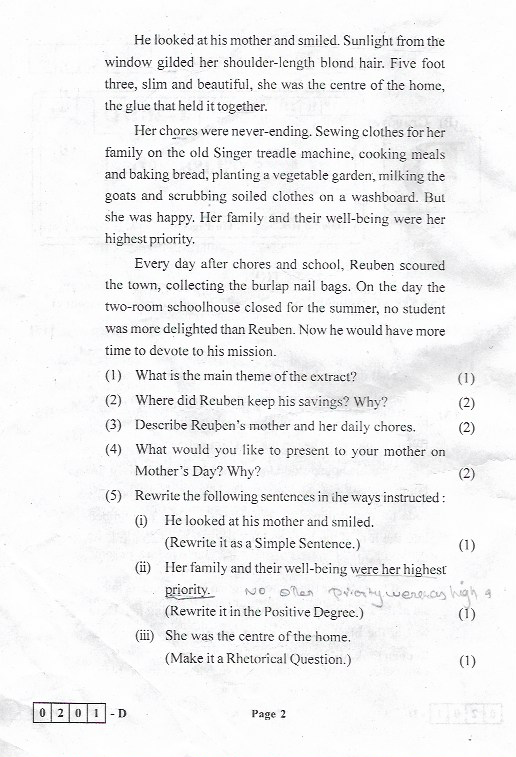
"That day Reuben found two sacks... ...Five foot three, slim and beautiful, she was the centre of the home... ...Now he would have more time to devote to his mission."
(1) What is the main theme of the extract?
The main theme of the extract is the love and devotion of a son, Reuben, towards his mother, and his determination to work hard to buy a special gift for her despite their financial struggles.
(2) Where did Reuben keep his savings? Why?
Reuben kept his savings in a rusty baking-soda tin which he hid beneath a pile of sweet-smelling hay in the loft of the ancient barn. He did this to keep his "mission" and savings a secret from his family until he had enough money.
(3) Describe Reuben’s mother and her daily chores.
Reuben's mother, Dora, was five foot three, slim, beautiful, and had shoulder-length blond hair. She was the centre of the home. Her daily chores were never-ending and included sewing clothes on an old Singer treadle machine, cooking meals, baking bread, planting a vegetable garden, milking the goats, and scrubbing soiled clothes on a washboard.
(4) What would you like to present to your mother on Mother’s Day? Why?
I would like to present a hand-made photo album to my mother on Mother's Day. It would contain memories of our happiest moments together. This gift would show her how much I cherish our time together and appreciate her love, which is more valuable than any expensive store-bought item.
(5) Rewrite the following sentences in the ways instructed:
(i) He looked at his mother and smiled. (Rewrite it as a Simple Sentence.)
Looking at his mother, he smiled.
(ii) Her family and their well-being were her highest priority. (Rewrite it in the Positive Degree.)
No other priority of hers was as high as her family and their well-being.
(iii) She was the centre of the home. (Make it a Rhetorical Question.)
Wasn't she the centre of the home?
(6) Find out the words from the extract which mean –
(i) dried grass
hay
(ii) routine tasks
chores

(B) Grammar: Do as directed

(i) He wanted to become ______ artist and live in ______ Himalayas. (Fill in the blanks with the appropriate articles.)
He wanted to become an artist and live in the Himalayas.
(ii) She was able to talk ______ the group ______ her experience. (Fill in the blanks with suitable prepositions.)
She was able to talk to the group about her experience.
(iii) “Why are you crying?” said the woman to a little boy. “I want a balloon,” he said. (Change it into Indirect Speech.)
The woman asked the little boy why he was crying. He replied that he wanted a balloon.

Q. 2. (A) Read the following extract and answer the questions given below:

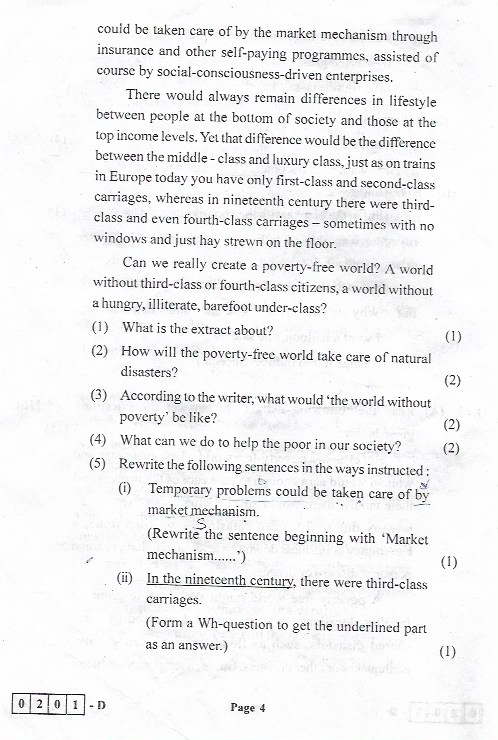
"But even in a poverty-free world... ...Can we really create a poverty-free world? A world without third-class or fourth-class citizens..."
(1) What is the extract about?
The extract is about the concept of a poverty-free world, distinguishing between structural poverty and temporary hardship caused by disasters, and envisioning a society where dignity is universal.
(2) How will the poverty-free world take care of natural disasters?
In a poverty-free world, natural disasters and temporary problems would be taken care of by the market mechanism through insurance and other self-paying programmes, assisted by social-consciousness-driven enterprises.
(3) According to the writer, what would 'the world without poverty' be like?
According to the writer, a world without poverty would be one without third-class or fourth-class citizens, and without a hungry, illiterate, barefoot under-class. It would be a world where differences exist in lifestyle (luxury vs. middle class) but not in basic human dignity.
(4) What can we do to help the poor in our society?
To help the poor in our society, we can donate to reputable charities, volunteer our time for education and skill-development programs, and support businesses that pay fair wages. We can also treat everyone with respect and dignity regardless of their economic status.
(5) Rewrite the following sentences in the ways instructed:
(i) Temporary problems could be taken care of by market mechanism. (Rewrite the sentence beginning with 'Market mechanism......')
Market mechanism could take care of temporary problems.
(ii) In the nineteenth century, there were third-class carriages. (Form a Wh-question to get the underlined part as an answer.)
When were there third-class carriages?
(iii) There would still be situations of temporary poverty. (Rewrite it using 'can'.)
There can still be situations of temporary poverty.
(6) What do the following words in the extract mean –
(i) devastated
destroyed / ruined
(ii) hay
dried grass

(B) Note-making:

Read the following extract carefully and present the information in the form of notes with the help of the given clues:
Extract about Sarvepalli Radhakrishnan...
Title Sarvepalli Radhakrishnan
Birth 5th September, 1888
Qualifications B.A., M.A.
Introduced thinking of Western idealist philosophers, and translated it into Indian thought.
Work Translated Indian Philosophy into standard academic jargon
Ambassador to the Soviet Union
Honours National: Bharat Ratna
International: Templeton Prize
Order of Merit

Q. 3. (A) Read the following extract and answer the questions given below:

"Kalpana Chawla was extremely proud of her birth-place... ...He went to her school and college, met her family, teachers and friends and scattered her ashes over the Himalayas."
(1) What is the extract about?
The extract is about Kalpana Chawla’s deep connection to her Indian roots, her humble nature, her concern for the environment, and her husband fulfilling her wish to have her ashes scattered in the Himalayas.
(2) How was Kalpana connected with India and Indians?
Kalpana was extremely proud of her birthplace and tried to bring it into the limelight. During space flights, she pointed India out to fellow astronauts. Despite her fame, she tracked down former teachers and friends in India to stay in touch, showing a keen desire to maintain her connection.
(3) How was Kalpana concerned about the well-being of the earth?
Kalpana was concerned about the well-being of the earth and always urged young people to listen to the sounds of nature and take care of the fragile planet. She also took many breathtaking photographs of the earth for terrestrial studies.
(4) What would you like to do for India?
I would like to contribute to India's development by promoting education in rural areas. By ensuring that every child has access to quality education, we can build a stronger, more progressive nation, just as Kalpana inspired others through her achievements.
(5) Rewrite the following sentences in the ways instructed:
(i) She took many breathtaking photographs of the earth. (Rewrite it using the Present Perfect Continuous tense.)
She has been taking many breathtaking photographs of the earth.
(ii) He scattered her ashes over the Himalayas. (Rewrite it beginning with 'Her ashes.....')
Her ashes were scattered over the Himalayas by him.
(iii) Kalpana was extremely proud of her birth-place and made every effort to bring it into limelight. (Rewrite it using 'not only ..... but also'.)
Kalpana was not only extremely proud of her birth-place but also made every effort to bring it into limelight.
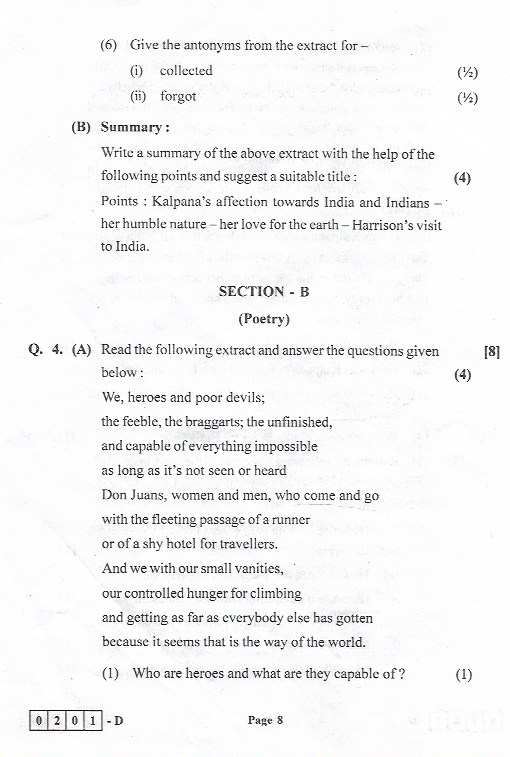
(6) Give the antonyms from the extract for –
(i) collected
scattered
(ii) forgot
remembered

(B) Summary:

Write a summary of the above extract with the help of the following points and suggest a suitable title.

Kalpana’s Eternal Bond with Earth and India

Kalpana Chawla, despite her celebrity status as an astronaut, remained humble and deeply connected to her Indian roots. She took pride in her birthplace, staying in touch with old friends and teachers. Beyond her patriotism, she harbored a deep concern for the Earth's well-being, urging youth to protect the fragile planet. Although she could not return to India alive, her husband, Harrison, fulfilled her cherished desire by visiting her alma maters and scattering her ashes over the Himalayas, forever uniting her with the land she loved.

SECTION - B
(Poetry)

Q. 4. (A) Read the following extract and answer the questions given below:

"We, heroes and poor devils; the feeble, the braggarts; the unfinished... ...because it seems that is the way of the world."
(1) Who are heroes and what are they capable of?
According to the extract, the "heroes" (who are also referred to as poor devils) are ordinary people. They are capable of "everything impossible" as long as their actions are not seen or heard by others.
(2) According to you, what difficulties do the middle-class people face?
Middle-class people often face the struggle of balancing aspirations with reality. They deal with financial constraints, societal pressure to succeed ("climbing"), and the feeling of being unnoticed or "unfinished" while trying to maintain a respectable appearance in society.
(3) Name and explain the figure of speech in the following line: "... Women and men, who come and go."
Antithesis: The opposite words 'come' and 'go' are used in the same line to convey the transient nature of life.
(4) Pick out the line from the extract, which shows the overambitious nature of the middle-class people.
"our controlled hunger for climbing"

(B) Read the following extract and answer the questions given below:

"All the rest of her children, she said, are on the nuclear blacklist of the dead... ...Peace is indeed a pregnant woman Peace is a mother."
(1) What is the situation of the children in absence of peace?
In the absence of peace, the children are described as being on the "nuclear blacklist of the dead," implying they are in mortal danger and facing the threat of annihilation due to war.
(2) Why should we avoid wars?
We should avoid wars to protect innocent lives, especially children, from destruction and death. Avoiding war allows peace to nurture life and brings a "moonlit message" of hope rather than the darkness of conflict.
(3) Name and explain the figure of speech in the following line: "that peace is a woman."
Metaphor: Peace is directly compared to a woman (and later a mother/pregnant woman) to emphasize its life-giving, nurturing, and gentle qualities.
(4) What message does the poet give through this poem?
The poet conveys the message that peace is vital for the survival of humanity. Peace is portrayed as a mother who nurtures and protects life, while war is a destructive force that threatens the future of all children.

SECTION - C
(Rapid Reading and Composition)

Q. 5. (A) Read the following extract and rewrite it from the point of view of Roma:

[You may begin with : Herman and I shared the backseat of Sid’s car.......]

Herman and I shared the backseat of Sid’s car. As European Jews who had survived the war, we were aware that much had been left unsaid between us. I broached the subject, "Where were you during the war?" I asked softly.

"The camps," he said, the terrible memories still vivid, the irreparable loss, he had tried to forget. But you can never forget.

I nodded, "My family was hiding on a farm in Germany, not far from Berlin," I told him. "My father knew a priest, and he got us Aryan papers."

I imagined how he must have suffered too, fear, a constant companion. And yet here we were both survivors, in a new world.

"There was a camp next to the farm," I continued. "I saw a boy there and I would throw him apples every day."

What an amazing coincidence that I had helped some other boy. "What did he look like?" he asked.

"He was tall, skinny and hungry. I must have seen him every day for six months."

(B) Read the following extract and convert it into a continuous write-up in about 120 words:

[You may begin with : Mrs Green was asking to come in ......]

Mrs Green was asking to come in. My mother welcomed her warmly, asking her to sit down and inquiring if she required a room. Mrs Green politely declined the room for the day, explaining that she was staying with Padre Dutt who had insisted on putting her up. However, she mentioned she might want a room for a day or two later, just for old times' sake.

The narrator remarked that she had stayed there before. Mrs Green confirmed it was a long time ago and revealed that she was the "missing Mrs Green"—the very one for whom the narrator's mother had put up a handsome tombstone in the cemetery. She expressed how touched she was by the gesture and was glad the inscription didn't say 'Beloved Wife of Henry Green,' as she confessed she didn't love him any more than he loved her.

SECTION - D
(Written Communication)

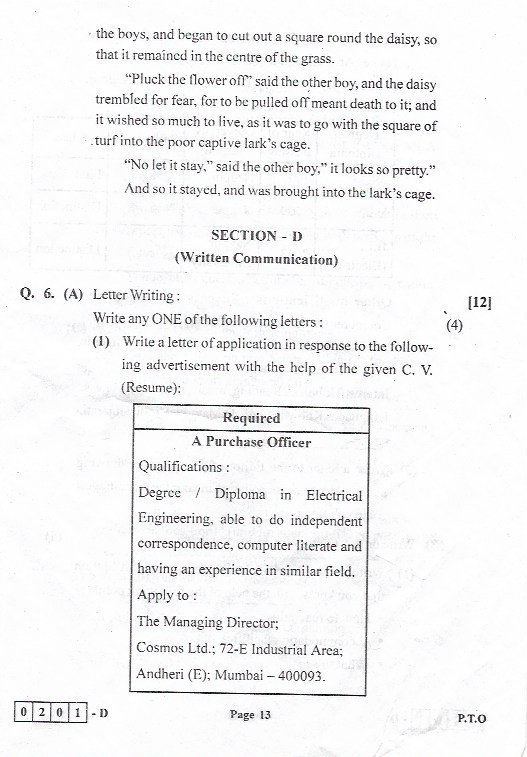
Q. 6. (A) Letter Writing:

Write a letter of application in response to the advertisement for a Purchase Officer.

Aruna Anil Shinde
B1-104, Rose Parade,
S. B. Road, Nagpur.

Date: 26th February 2018

To,
The Managing Director,
Cosmos Ltd.,
72-E Industrial Area,
Andheri (E), Mumbai – 400093.

Subject: Application for the post of Purchase Officer.

Reference: Your advertisement in 'The Daily Times' dated 25th February 2018.

Respected Sir/Madam,

With reference to the advertisement mentioned above, I wish to apply for the post of Purchase Officer in your esteemed organization. I have the necessary qualifications and experience required for this position.

I have completed my B.E. (Electrical) from Nagpur University with distinction (78%) in 2013. Additionally, I have successfully completed a Computer Diploma from NIIT, Nagpur in 2014, making me proficient in computer operations necessary for independent correspondence and inventory management.

I possess relevant work experience, having worked as a Purchase Officer at Login Private Ltd., Nagpur for the past three years. I am looking for better career prospects and a challenging environment to grow, which I believe Cosmos Ltd. can provide.

I have enclosed my C.V. for your kind perusal. I hope for a positive response and an opportunity to be interviewed.

Thanking you,

Yours faithfully,

(Signature)
Aruna Anil Shinde

Encl: Curriculum Vitae


CURRICULUM VITAE

Name: Aruna Anil Shinde

Address: B1-104, Rose Parade, S. B. Road, Nagpur.

Date of Birth: 15th August 1991

Email: aruna.shinde@email.com

Educational Qualifications:

Degree/Diploma Year University/Board Percentage Class
B.E. (Electrical) 2013 Nagpur University 78% Distinction
HSC 2009 Nagpur Board 76% Distinction
SSC 2007 Nagpur Board 72% First

Other Qualifications: Computer Diploma from NIIT, Nagpur (2014).

Work Experience: 3 Years as Purchase Officer at Login Private Ltd., Nagpur.

Languages Known: English, Marathi, Hindi, Gujarati.

Hobbies: Reading, music, swimming, chess.

(B) Write on any ONE of the following items:

(1) Write a short tourist’s leaflet about any Hill Station that you know with the help of the following points:

VISIT MAJESTIC MATHERAN

The Pollution-Free Paradise

How to Reach There:

  • By Rail: Nearest railhead is Neral Junction on the Central Railway. From Neral, take the famous Toy Train or a taxi to Dasturi Naka.
  • By Road: Well connected by road from Mumbai (100 km) and Pune (120 km). Vehicles must be parked at Dasturi Naka.

Accommodation Facilities:

  • Luxury Heritage Hotels like The Verandah in the Forest.
  • Budget-friendly lodges and MTDC resorts are available.
  • Homestays for a local experience.

What to See:

  • Panorama Point: For a 360-degree view of the surrounding hills.
  • Charlotte Lake: The main water source and a serene picnic spot.
  • Echo Point: Shout and hear the mountains answer back!
  • Louisa Point: Offers majestic views of the Prabal Fort.

Shopping Attractions:

  • Famous for leather goods (Kolhapuri chappals, bags).
  • Chikki (sweet peanut brittle) and honey.
  • Handicrafts and cane items.

Anything Special:

Matheran is Asia's only automobile-free hill station! Enjoy horse riding and hand-pulled rickshaws in the fresh, unpolluted air.

(C) Write on any ONE of the following items:

(1) Read the following tree diagram about ‘Morphemes’ and write a short paragraph on it.

Classification of Morphemes

Morphemes are defined as the smallest linguistic units within a word that can carry a meaning. They are broadly classified into two main categories: Free Morphemes and Bound Morphemes. Bound Morphemes are further subdivided based on their position and function. Based on position, they are classified into Prefixes (initial position), Infixes (middle position), and Suffixes (final position). Based on function, Suffixes can be categorized into Derivational, which are class-changing (changing the grammatical category of the word), and Inflexional, which are class-maintaining (keeping the word in the same grammatical category) and attached to a Bound base.

Q. 7. Answer the following questions as per instructions:

(A) Framing Questions:
Interview a well-known sports personality (Chief Guest at Annual Sports Prize Distribution). Frame 8-10 questions.

Interview Questions for Ms. P.V. Sindhu (Badminton Player)

  1. Welcome to our college, Ma'am. How does it feel to be back in a college atmosphere?
  2. At what young age did you decide that badminton was your true calling?
  3. Who has been your biggest inspiration and support system throughout your journey?
  4. Could you share some of the biggest challenges you faced during your early training years?
  5. You have won numerous medals. Which specific match or victory is closest to your heart and why?
  6. How do you handle the immense pressure and expectations before a major international tournament like the Olympics?
  7. What is your daily fitness regimen and diet plan that keeps you in such great shape?
  8. How do you balance your personal life with the demanding schedule of a professional athlete?
  9. What changes would you like to see in the sports infrastructure in India to support upcoming talent?
  10. Finally, what message would you like to give to the aspiring young athletes of our college?
(B) Speech Writing:
Topic: ‘Save Trees, Trees Save’. Points: Providers of human needs, ecological balance, rainshowers, etc.

Save Trees, Trees Save

Respected Principal, teachers, and my dear friends,

A very good morning to all of you. Today, I stand before you to speak on a topic that is not just a slogan, but a lifeline for our survival: "Save Trees, Trees Save."

Since the dawn of civilization, trees have been the silent providers of human needs. They give us the very air we breathe, the food we eat, the wood for our shelter, and medicines to heal our bodies. Yet, in our greed for urbanization, we are ruthlessly cutting them down.

We must realize that trees are the guardians of our ecological balance. They hold the soil together, preventing erosion, and play a crucial role in the water cycle, bringing timely rainshowers that feed our agriculture. Without trees, we invite droughts, floods, and global warming. A world without trees is a world without a future.

Friends, it is time to act. Let us pledge today not to cut trees but to plant more of them. Let us protect our green cover to ensure a healthy environment for ourselves and generations to come. Remember, if we save trees, trees will save us.

Thank you.

Title: HSC English 2018 Question Paper Solution Set D - Maharashtra Board Labels: HSC Board, English Question Paper, 2018 Solution, Maharashtra Board, Class 12, Exam Preparation, Solved Paper Permanent Link: hsc-english-2018-question-paper-solution-set-d-maharashtra-board Search Description: Complete solution for HSC Class 12 English Question Paper 2018 Set D. Includes Grammar, Note-making, Summary, and Writing Skills answers.